
Meta title character limit: 60 characters, mostly
The meta title character limit that everyone quotes is 60 characters, and that number is right for the wrong reason. Google doesn’t count characters at all: it cuts your title where the screen ends, measured in pixels. Sixty characters is simply the length that survives that cut on most devices. Shopify, meanwhile, happily accepts 70 characters in the field and lets the last ten vanish in the search results.
This guide sorts the numbers out properly: what each limit actually is, field by field, with sources. Why Google sometimes rewrites a title that fit perfectly. And templates for product, collection, and homepage titles that survive both the cut and the rewrite. It’s the writing half of the job; the automation half has its own guide.
One definition to keep from that guide: a meta title is the headline of a free ad Google runs for your page, and the meta description is its body copy. Every limit below is just the column width of that ad.
The meta title character limit is a pixel budget
There is no official meta title character limit: Google truncates title links to fit the searcher’s screen, which lands near 60 characters in practice. Google’s title link documentation is clear that the title element itself has no length cap; the display gets cut as needed, typically at the device width. A wide desktop shows more than a narrow phone, and no character count maps exactly onto either.
So treat 60 as a safety rail, not a spec. And draw the practical conclusion, which matters more than the exact number: front-load. The first 30 characters of your title show on every screen that exists, so the search term belongs there, not warming up behind “Welcome to” or “Shop the best”. Whatever gets cut should be the part you’d miss least, which is why the brand name goes last.
Shopify’s limits: 70 in the field, 60 on the screen
Shopify’s page title field accepts up to 70 characters, and Shopify’s own SEO documentation advises less: “consider keeping your title up to 60 characters”. For the meta description, the same page recommends about 160 characters. The fields live under Search engine listing at the bottom of the product editor, and the same section exists on collections, pages, and blog posts.
Here’s the whole picture in one table:
| Field | Shopify’s field | Working limit | Who enforces it |
|---|---|---|---|
| Meta title (page title) | up to 70 characters | 60 | Google, by pixel width |
| Meta description | about 160 recommended | 155 | Google, by pixel width |
| Image alt text | free text | 125 | screen reader convention |
My rule, stated as a rule: treat 60 as the limit and Shopify’s extra ten characters as rope. A 68-character title isn’t wrong, it’s just gambling its own ending. I write to 60, and to 155 on descriptions rather than Shopify’s 160, for the same reason: the margin costs one adjective and buys a clean cut on every device.
The alt text row is the odd one out: nothing truncates it in search results. The 125-character convention comes from screen readers, and the alt text guide covers that field properly.
Why Google rewrites titles anyway
Fitting the character limit doesn’t guarantee your title shows: Google replaces title links it considers half-empty, boilerplate, outdated, or mismatched with the page. Its documentation lists the triggers plainly, and they map to habits Shopify stores fall into without noticing:
- Repeated boilerplate. Every page titled “Product Name | Best Store | Free Shipping | Shop Now” teaches Google your titles carry no information, and it starts writing its own.
- Outdated years. A title still saying 2024 invites a rewrite. Use the year only where it’s true and maintained.
- Titles that don’t match the page. If the visible heading says one thing and the title tag another, Google may prefer the heading. Keep your product title and page title telling the same story.
- Half-empty titles. “Home” and “Untitled” get replaced with whatever Google finds: your H1, anchor text, or other on-page text.
The fix is the same discipline in every case: one unique, accurate title per page that matches what a visitor sees. Not because Google demands elegance, but because the rewrite is what happens when your title loses an argument with your own page.
Title templates that fit
A product meta title that fits is the search term first, one qualifier, and the brand last: “Non-Slip Hot Yoga Mat, 6mm | Brandname” runs 38 characters and leaves room for a color or size. The pattern by page type:
- Product: search term, key attribute, brand. “Ceramic Pour Over Coffee Set, 600ml | Brandname” (47 characters).
- Collection: category for audience, brand. “Trail Running Vests for Long Distances | Brandname” (50 characters).
- Homepage: brand first, then what you sell in plain words. “Brandname: Handmade Ceramic Coffee Gear” (39 characters).
(I count characters for a living now. The computer science degree is thrilled.)
Two habits finish the job. Cut filler verbs: “Buy”, “Shop”, and “Welcome to” spend budget on words nobody searches. And skip the keyword pile-up: “Yoga Mat | Non Slip Yoga Mat | Best Yoga Mat” reads as spam to people and machines alike, and it’s exactly the boilerplate pattern that invites a rewrite.
The meta description: 155 characters of ad copy
A meta description that earns clicks fits one benefit, one differentiator, and one reason to click into about 155 characters. It’s not a ranking input, so write it purely for the human deciding between your result and the one below it:
Weak: We sell high quality yoga mats in many colors. Fast shipping. Great customer service. Order today.
Better: The mat that grips when your hands don’t. 6mm cushion, machine washable, free 30-day returns.
The second is 93 characters, which is fine: under the limit costs nothing if the message is complete. Over it, Google cuts the ending, so put the claim first and the reassurance after. And keep it honest; the snippet is a promise, and a page that breaks it gets its visitor back in three seconds.
Leave it blank and Google assembles a snippet from your page text, often the first line of your description. That fallback is the strongest argument for a benefit-led opening line, but it’s still a coin flip you can buy out of for 155 characters.
Filling both fields across a catalog
The math is the real enemy: at two minutes per title-and-description pair, a 1,000-product catalog is 33 hours of typing into small boxes, which is why the fields sit empty on most stores. Willpower doesn’t fix arithmetic; a workflow does.
This is part of why I built InkForge, an AI product description app for Shopify with preview and rollback. One credit covers one product’s description, meta title, meta description, and image alt text, generated in your brand voice and inside the limits from the table above. Every field shows in a preview next to what’s currently live, you approve or edit per product, and version history keeps the old values one click from restored. The free plan covers 50 products a month; the $15 Starter plan covers 500.
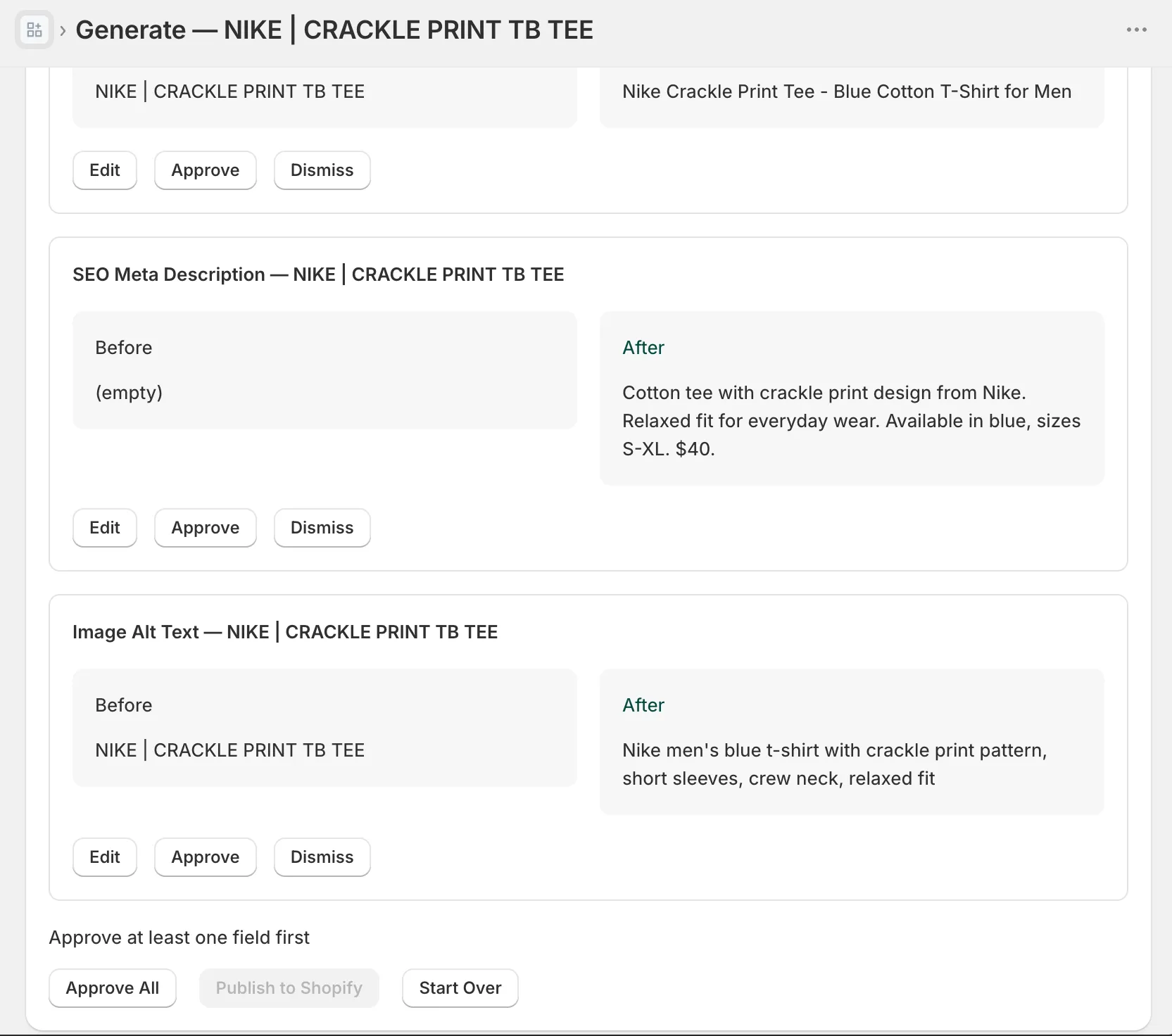
Whichever route you take, keep a review pass. Meta fields are short; skimming 100 of them is a coffee’s worth of work, and you’re checking three things: the search term is really in the title, the promise matches the page, and the first 30 characters could stand alone.
Start with the bestsellers, since those pages already earn impressions their snippets aren’t converting. If you’d rather the fields came filled and previewed, the free plan covers your first 50 products, which is a bestseller list on most stores.
FAQ: meta title and description limits
What is the meta title character limit for Google? There’s no official one. Google truncates title links to fit the searcher’s screen, measured in pixels, not characters. In practice, titles up to about 60 characters survive on both desktop and mobile, which is why 60 is the working limit worth holding.
How long can a Shopify page title be? Shopify’s page title field accepts up to 70 characters, and Shopify’s own SEO documentation suggests staying around 60 to avoid shortened titles in search results. The gap between 60 and 70 is text Google will usually cut.
Is the meta description limit 155 or 160 characters? Neither is official; Google truncates by pixel width. Shopify’s documentation recommends about 160 characters. I hold mine to 155 for margin, and front-load the message so a cut ending costs nothing either way.