
InkForge vs StoreYa ChatGPT-AI: brand voice and rollback
StoreYa’s ChatGPT-AI Product Description has 331 reviews. Mine has none. So the bias goes on the table before the table: I build InkForge, the competing app, every number below comes from the two public App Store listings as of August 2026, and where StoreYa’s app is better I’ll say so in plain words.
It is better, today, at breadth. If you want one tool that writes product descriptions, collection pages, blog posts, and newsletters, install StoreYa’s app and stop reading. The rest of this comparison is for merchants with two narrower questions: how deep does the brand voice go, and what happens to your store after you click Generate on a big batch.
What StoreYa ChatGPT-AI does well
StoreYa’s ChatGPT-AI Product Description earns its 4.9 stars with range: product and collection descriptions, blog posts, newsletters, and image copy, in any language, on the App Store since February 2023. The listing also covers something none of its competitors mention: an LLM.txt file, so AI assistants like ChatGPT can find and describe your store. Whatever you think of that bet, it’s current thinking, not a template from 2023.
The pricing is generous too. The Starter plan at $15 per month includes 2,500 credits, five times what my app gives at the same price, and the tiers above scale to 12,000 credits for $30 and 120,000 for $100. The free plan covers up to 120 descriptions, added manually one at a time.
And credit where it’s due on review: generated descriptions can be edited before they publish. That’s a real checkpoint, and more than most of this category offers.
What InkForge does differently
InkForge, an AI product description app for Shopify with preview and rollback, stays on the product page and goes deeper into it. One credit covers one complete product: the description, the meta title, the meta description, and the image alt text, in any of 29 languages. Every generation shows as a side-by-side diff against what’s live, bulk runs are approved or rejected per product, and version history rolls any change back in one click.
The free plan covers 50 products a month, one at a time, with the brand voice builder, the preview, and version history included; free is capped at one voice. The $15 Starter plan covers 500 products and adds bulk generation with per-row approval and unlimited brand voices.
Full disclosure, again: InkForge launched in May 2026 and has zero reviews as I write this. StoreYa’s app has 331. (You can see why I’d rather talk about workflow than track records.)
InkForge vs StoreYa ChatGPT-AI, field by field
Everything below reflects the two public listings as of August 2026. “Not in listing” means the listing doesn’t mention it, which is worth knowing before a bulk run, even if the app quietly does more.
| InkForge | StoreYa ChatGPT-AI | |
|---|---|---|
| Rating (reviews) | none yet | 4.9 stars (331) |
| On App Store since | May 2026 | February 2023 |
| Free plan | 50 credits/mo, one product at a time | up to 120 descriptions, added manually |
| Cheapest paid | $15/mo, 500 credits | $15/mo, 2,500 credits |
| What one credit buys | one product: description, meta title, meta description, alt text | one generated text |
| Beyond product pages | no | collections, blogs, newsletters, images, LLM.txt |
| Review before publish | side-by-side diff | edit before publishing |
| Per-product approval in bulk | yes | not in listing |
| Version history and rollback | yes, one click | not in listing |
| Brand voice | audience, personality, banned words | tone and style options |
| Image alt text | yes | not in listing |
| Languages | 29 | ”any language” |
One warning about the credit rows: the units aren’t comparable. At StoreYa’s $15 you get 2,500 generated texts; at mine you get 500 complete products with four fields each. If plain descriptions are all you need, StoreYa’s per-text price is far lower, and you should know that going in. Compare the monthly price against your catalog size, not credits against credits.
A tone dropdown is not a brand voice
The voice gap between these apps is structural: StoreYa’s listing offers tone and style options plus prompt templates, while InkForge stores your voice as three explicit decisions it applies to every generation. Here’s the definition I use everywhere: a brand voice is three decisions written down: who your audience is, how you sound, and which words you never use.
Tone presets skip the first and third decision. “Professional” means something different for a law firm and a sneaker store, and a tone dropdown can’t know which one you are. It also can’t know that your store never says “revolutionary”, never promises medical outcomes, and always calls customers “riders” instead of “users”. Those are exactly the edits you end up making by hand on every generated text, forever.
Here’s what the three decisions change in practice. Take the same water bottle in two stores. A voice built for trail runners, with “lightweight” on the banned list because everyone says it, gets copy about grams, one-handed caps, and third-hour-of-a-climb thirst. A voice built for desk workers gets copy about cup holders, condensation, and not ruining documents. A tone dropdown set to “friendly” gives both stores the same paragraph.
My opinion, stated plainly: tone presets produce copy that could belong to any store in your niche, and interchangeable copy is the problem you installed an AI app to fix.
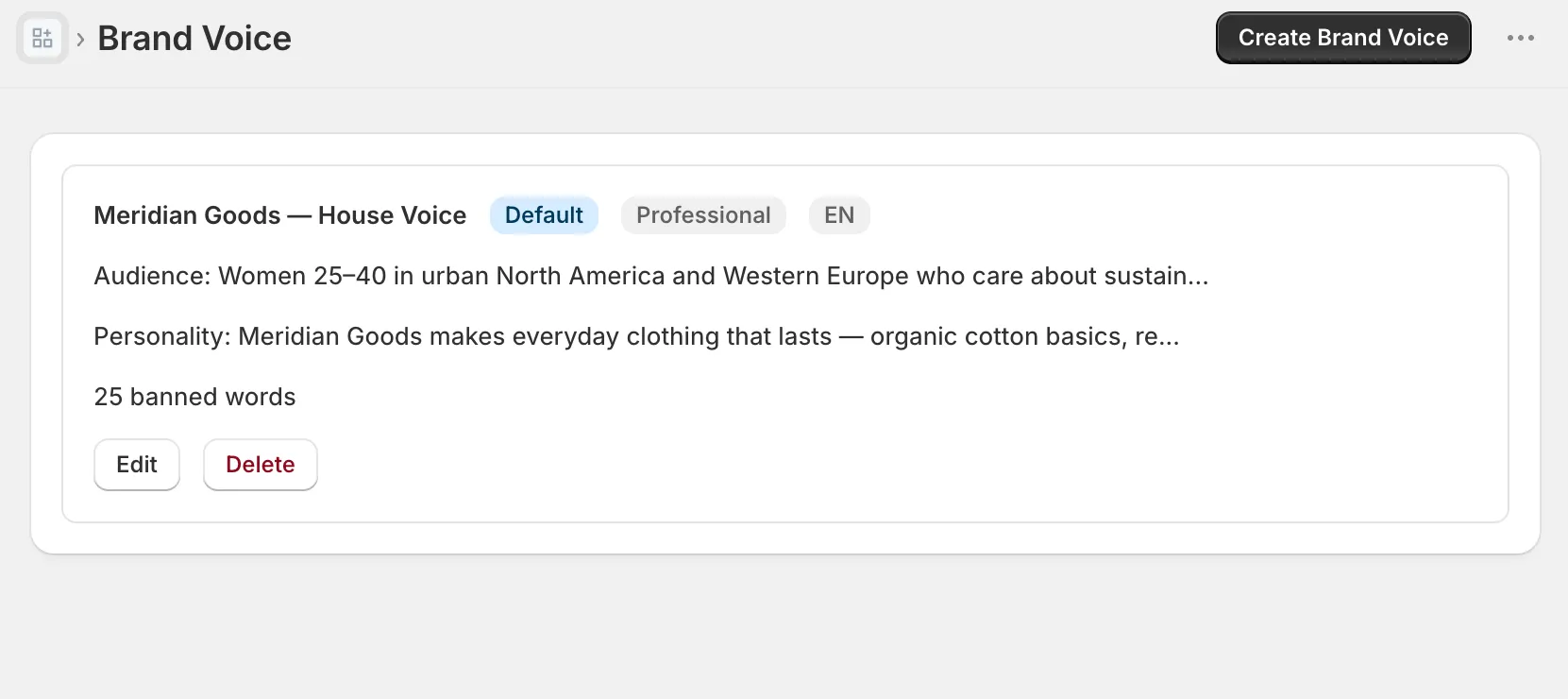
To be fair, StoreYa’s prompt templates can carry some of this if you write your audience and banned words into them yourself. The difference is whether the app holds the voice for you, or you re-type it into prompts and hope you’re consistent at product 400.
The rollback question, answered from public evidence
As of August 2026, StoreYa’s listing doesn’t mention version history or rollback, and InkForge is built around both. The edit-before-publish step is real and worth crediting; it catches the bad generation you’re looking at. What it can’t do, at least as listed, is bring back the version you replaced last Tuesday.
Two fairness notes before I lean on this. Absence from a listing isn’t proof of absence from the app. And StoreYa’s track record is 331 reviews at 4.9 stars across three years, which is not the profile of a store-wrecker.
But the public record has one entry I’d weigh before a big batch. Among the app’s three one-star reviews sits a September 2023 merchant whose existing descriptions and SEO fields were replaced by the app’s output. One complaint out of 331 reviews is a footnote, not a pattern, and the other two one-star reviews concern billing and output quality, not lost work. It’s just that this story is exactly the kind that version history turns from a support ticket into a click.
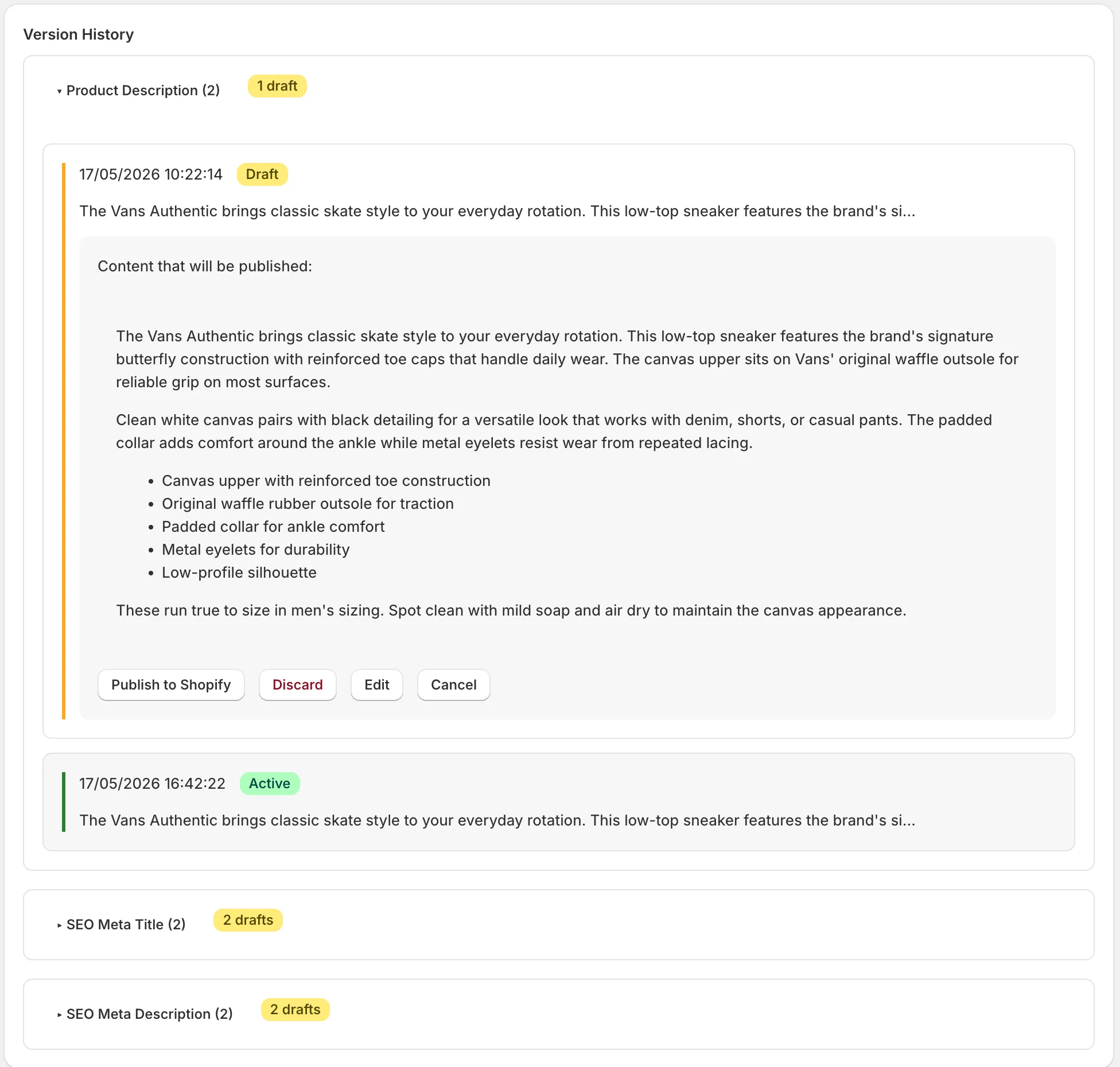
And whichever app you pick, build the free half of the safety net yourself: Products, Export, CSV, before every batch. It takes 30 seconds and it’s step 4 of the bulk cleanup workflow.
Which one for your store
Choose by the job, not by this blog:
- Choose StoreYa’s app if you want breadth: blogs, newsletters, collections, an LLM.txt file, and 2,500 credits for $15.
- Choose InkForge if you want depth on the product page: a voice with your audience and banned words baked in, all four SEO fields per credit, and bulk edits you can inspect first and undo after.
- Unsure? Both have free plans. Run the same 20 products through each and compare what landed, what you saw before it landed, and how each undo works. If you start with mine, give it your worst description first; the free 50 products are enough to judge.
For the wider field, including Profitonium and Avada, the 2026 category comparison runs all four apps through the same questions.
FAQ: InkForge vs StoreYa
Is StoreYa’s ChatGPT-AI Product Description app good? Yes. As of August 2026 it holds 4.9 stars across 331 reviews, writes product and collection descriptions plus blog posts and newsletters, and its $15 Starter plan includes 2,500 credits. Descriptions can be edited before publishing. The listing doesn’t mention version history or rollback.
What’s the difference between InkForge and StoreYa’s app? Breadth versus depth. StoreYa’s app writes beyond the product page: blogs, newsletters, images, and an LLM.txt file. InkForge writes the product page only, but deeper: one credit fills the description, meta title, meta description, and alt text, with a three-part brand voice, a preview diff, per-product approval, and one-click rollback.
Does StoreYa’s AI description app have rollback or version history? Its public App Store listing doesn’t mention version history or rollback as of August 2026. That’s not proof the app lacks them. But for a feature that decides whether a bulk edit is reversible, I’d want it confirmed in writing before running a big batch.