
Best AI product description apps for Shopify (2026)
Search the Shopify App Store for the best AI product description app and you get pages of nearly identical listings, all promising SEO-ready copy in one click. I build one of those apps, so this is not a neutral roundup, and pretending otherwise would insult you. (Ranking my own app in my own roundup is suspicious, I know. Every number below links to its source; check my math.)
So here are the ground rules. Every figure comes from the public App Store listings, checked in August 2026. I’ll say plainly what my competitors do better than my app, because they do. And the test everything gets ranked by is stated out loud: what happens to your store after you click Generate on 500 products.
The short answer for skimmers: Profitonium’s app is the volume veteran, StoreYa’s does the most beyond product pages, Avada’s gives you the most credits per dollar, and mine is the one built around preview and rollback. The rest is evidence.
The five questions that separate these apps
Ask five questions of any description app and the marketing fog clears: can I preview changes before they publish, is there an undo, does it hold a real brand voice or just a tone dropdown, does it touch my theme code, and does support actually answer.
- Can I preview before publish? Generated text you can’t inspect before it goes live isn’t automation, it’s gambling.
- Is there an undo? Shopify keeps no version history of product content. If the app doesn’t either, a bad batch is permanent.
- Brand voice or tone dropdown? “Professional” means different things to a law firm and a sneaker store. A real voice holds your audience, your phrasing, and your banned words.
- Does it touch theme code? A description app writes product data and never needs theme access. None of the four here advertise theme edits; if an app you’re evaluating asks for theme permissions, ask why.
- Does support answer? Read the newest one-star reviews of any app before installing, mine included, and see whether the developer replied.
Generation quality didn’t make the list because it stopped being the differentiator: every serious app now produces clean copy from decent inputs. The differences live in what happens around the generation.
The four apps, honestly
Profitonium: ChatGPT AI Product Description
Profitonium’s ChatGPT AI Product Description is the veteran: on the App Store since 2021, 4.9 stars across 467 reviews, which is the biggest verified track record in the category. It generates descriptions, meta fields, alt text, and tags in 30+ languages, can analyze product images, and auto-generates content when you add new products. The free plan includes 100 credits a month; paid starts at $19/month for 2,000 credits. If your metric is proven volume, this is the reference point. What the listing doesn’t mention: a preview step, per-product approval in bulk runs, or any rollback.
StoreYa: ChatGPT-AI Product Description
StoreYa’s ChatGPT-AI Product Description has 4.9 stars across 331 reviews and the broadest content range: product descriptions plus blog posts, newsletters, and an LLM.txt file for AI-assistant visibility. Free covers 120 descriptions; $15/month buys 2,500 credits. Descriptions can be edited before publishing, which is more review than most of the category offers. What the listing doesn’t mention: version history or a rollback for bulk runs.
Avada: AI Product Description
Avada AI Product Description is the newest of the three, on the store since 2025, at 4.9 stars across 120 reviews. It’s the credits-per-dollar winner by a wide margin: $14.90/month buys 5,000 credits, the free plan starts you with 150, and the Pro tier runs on current frontier models with custom templates and an image reader. Support is advertised as 24/7. What the listing doesn’t mention: preview, per-product approval, or rollback.
InkForge: Product Descriptions
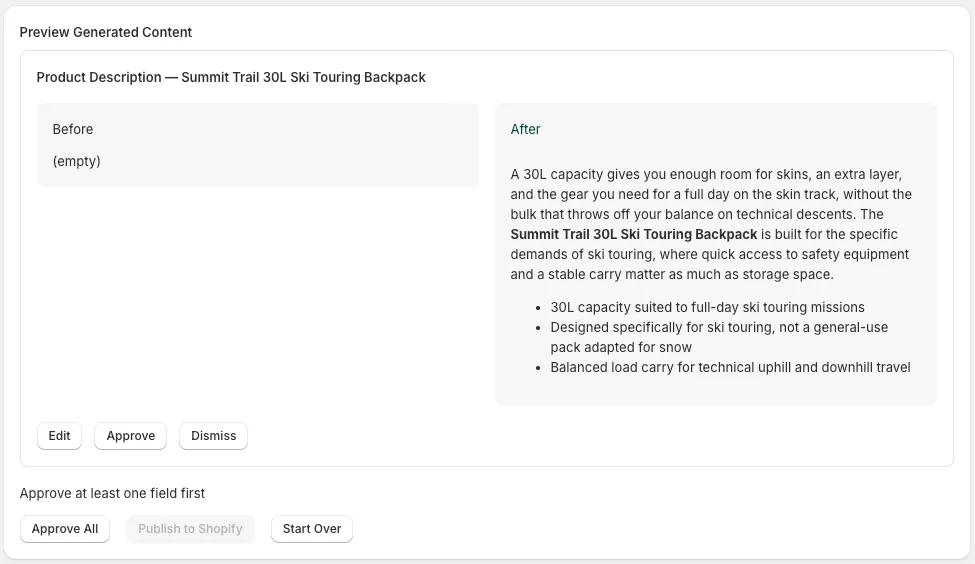
InkForge, an AI product description app for Shopify with preview and rollback, is mine, and it’s the newcomer: launched May 2026, zero reviews as I write this. You can see the asymmetry, and so can I. What it was built around is the part of the workflow the rest of the category leaves unstated: every generation shows as a side-by-side diff before publishing, bulk runs are approved or rejected per product, and version history restores any field in one click. One credit covers a whole product (description, meta title, meta description, alt text) in a brand voice built from your audience, personality, and banned words, in 29 languages. Free covers 50 products a month; $15/month covers 500.
Best AI product description apps for Shopify, compared
The claims above, in one table. “Not in listing” means exactly that: the public listing doesn’t mention the feature as of August 2026, which is worth knowing before you trust a catalog to it.
| Profitonium | StoreYa | Avada | InkForge | |
|---|---|---|---|---|
| Rating (reviews) | 4.9 (467) | 4.9 (331) | 4.9 (120) | none yet |
| On App Store since | 2021 | 2023 | 2025 | 2026 |
| Free tier | 100 credits/mo | 120 descriptions | 150 credits | 50 products/mo |
| Cheapest paid | $19/mo, 2,000 credits | $15/mo, 2,500 credits | $14.90/mo, 5,000 credits | $15/mo, 500 products |
| Meta title and description | yes | yes | yes | yes |
| Image alt text | yes | not in listing | not in listing | yes |
| Preview before publish | not in listing | edit before publish | not in listing | side-by-side diff |
| Per-product approval in bulk | not in listing | not in listing | not in listing | yes |
| Version history and rollback | not in listing | not in listing | not in listing | yes, one click |
| Brand voice | custom templates | tone and style options | templates | audience, personality, banned words |
One warning about that pricing row: credit units are not comparable across apps. In my app one credit is one complete product with all four fields; elsewhere a credit is closer to one generated text. Compare the monthly price against your catalog size, not credit counts against credit counts.
Where the whole category falls short
The category’s weak spot isn’t writing quality, it’s what happens after you click Generate on a large batch: across the four listings, mine is the only one that mentions rollback, and only two mention any review step at all. That’s not a hidden insult to my competitors; their generators are genuinely good. It’s a gap in what the category thinks merchants need.
The failure mode is documented, not hypothetical. Among StoreYa’s one-star reviews sits a 2023 merchant whose SEO fields were overwritten along with the descriptions: “whatever work you’ve had there gets replaced.” One review out of hundreds, and the app has improved since. But it’s the exact story a preview and a rollback exist to make impossible, and it’s why I keep repeating the same definition: a safe bulk editor is one where nothing is published until you approve it, and nothing you publish is more than one click from restored.
Whichever app you install, you can build half the safety net yourself in 30 seconds: Products, Export, CSV, before every bulk run. Old descriptions, meta fields, and all. I walk through the full workflow in the dropshipping cleanup guide.
Which app for which store
Match the app to the job, not to the star rating:
- Big multilingual catalog, volume first: Profitonium. The 2021-to-now track record and 30+ languages are the point.
- You want blogs and newsletters from the same tool: StoreYa. Nobody else in this list writes beyond the product page.
- Maximum credits per dollar: Avada. 5,000 credits for $14.90 is unmatched in this comparison.
- Bulk edits you can inspect and undo: InkForge. Preview diff, per-product approval, one-click rollback, all four SEO fields per credit. It also handles meta titles and descriptions across the catalog, which is the same workflow pointed at different fields.
And my honest advice, which applies to my own app first: don’t pay anyone until a free tier has proven output quality on your own products. All four apps here have real free plans. Pick two, run your 20 weirdest products through both, and let the output decide. If you start with mine, run it on your worst description first: the free 50 products are enough to judge it.
FAQ: best AI product description apps for Shopify
What is the best AI product description app for Shopify? There’s no single best. By track record the leaders are Profitonium’s ChatGPT AI Product Description (4.9 stars, 467 reviews) and StoreYa’s (4.9 stars, 331 reviews). Choose by workflow instead: raw volume and languages, content breadth, credits per dollar, or preview-and-rollback safety. Free tiers make testing two apps on 20 products the fastest way to decide.
Are AI product description apps safe to use on a live store? The generation is safe; the publishing is where stores get hurt. Before trusting any app with a bulk run, check three things: a preview before publish, per-product approval, and a rollback path. And export your products to CSV first, which gives you an undo no matter which app you use.
Do AI product descriptions hurt SEO? No. Google targets unhelpful content, not AI content. Feed the tool real product facts and a defined brand voice, review before publishing, and never mass-publish text you haven’t read.