
Free AI product description generators for Shopify, compared
Searching for a free AI product description generator lands you in two kinds of free: Shopify Magic, which is genuinely built into every Shopify plan, and app free tiers, which give you 50 to 150 credits and a meter. Both are real, both are useful, and neither listing goes out of its way to explain what the free version leaves out.
That’s this article. I build one of these apps, so I’m in the list too, and my free tier gets the same treatment as everyone else’s: what you get, whether it refreshes, and where the gate is. Every number comes from the public listings and documentation as of August 2026.
Start with Shopify Magic, the tool you already have
Shopify Magic is a free AI product description generator that’s already installed: it’s included with every Shopify plan, and it lives inside the product editor as a generate-text button on the description field. You feed it a prompt (Shopify’s own guide recommends at least the product title and two features, plus any tone and style instructions), and it drafts a description in place. It works in every language Shopify supports, on desktop only.
The limits are structural, not hidden. It writes one description at a time inside one product’s editor; there’s no bulk mode in the documentation. It covers the description field only, so your meta title, meta description, and image alt text stay manual. And there’s no memory of your voice: the tone instructions live in whatever prompt you type that day.
Under about 20 products, my honest advice is Shopify Magic and your own editing pass, and no app at all, including mine. (An app developer recommending the built-in tool first. My nonexistent marketing department is furious.) Even Shopify’s docs tell you to review generated text closely before publishing, and at that catalog size the review pass is an afternoon.
The chatbot route: free, but manual twice
ChatGPT, Claude, and Gemini are also free AI product description generators, and the writing quality is not the problem: several of the paid Shopify apps advertise the same model families you’d be chatting with directly. The problem is the workflow, which is manual in both directions. You copy the product facts out of Shopify, paste the result back in, and repeat per product, and nothing ever writes to the fields themselves: the description, the meta title, the meta description, and the alt text all travel by clipboard.
The voice has no home either. Whatever tone instructions you gave last Tuesday live in last Tuesday’s chat, so consistency across 100 products depends on you re-pasting the same prompt preamble every session. As a test kitchen for what AI can do with your products, a chatbot is excellent and costs nothing. As a catalog workflow, it’s a part-time job.
What a free AI product description generator includes, app by app
The free tiers differ on three axes: how much you get, whether it refreshes, and what’s gated behind the paid plan. All figures from the public listings, August 2026.
| Tool | Free amount | Refreshes? | What free leaves out |
|---|---|---|---|
| Shopify Magic | included with every plan | no meter listed | descriptions only, one product at a time, desktop only |
| Profitonium ChatGPT AI | 100 credits | monthly | no gates named on the listing |
| StoreYa ChatGPT-AI | up to 120 descriptions | not marked as renewing | added manually, one at a time; one blog post |
| Avada AI Product Description | 150 credits | not marked as renewing | smaller model (ChatGPT 4.1 mini), 20 outputs per run, system templates only |
| InkForge | 50 credits | monthly | bulk generation, and more than one brand voice (both on the $15 plan) |
Profitonium’s listing is the volume outlier: 100 credits every month, with descriptions, meta fields, alt text, and 30+ languages on the menu and no feature gates named. StoreYa’s free plan covers up to 120 descriptions added manually, plus a one-time blog post. Avada’s starts you with 150 credits but swaps in the smaller ChatGPT 4.1 mini model and caps runs at 20 outputs; the frontier models are on the $14.90 plan.
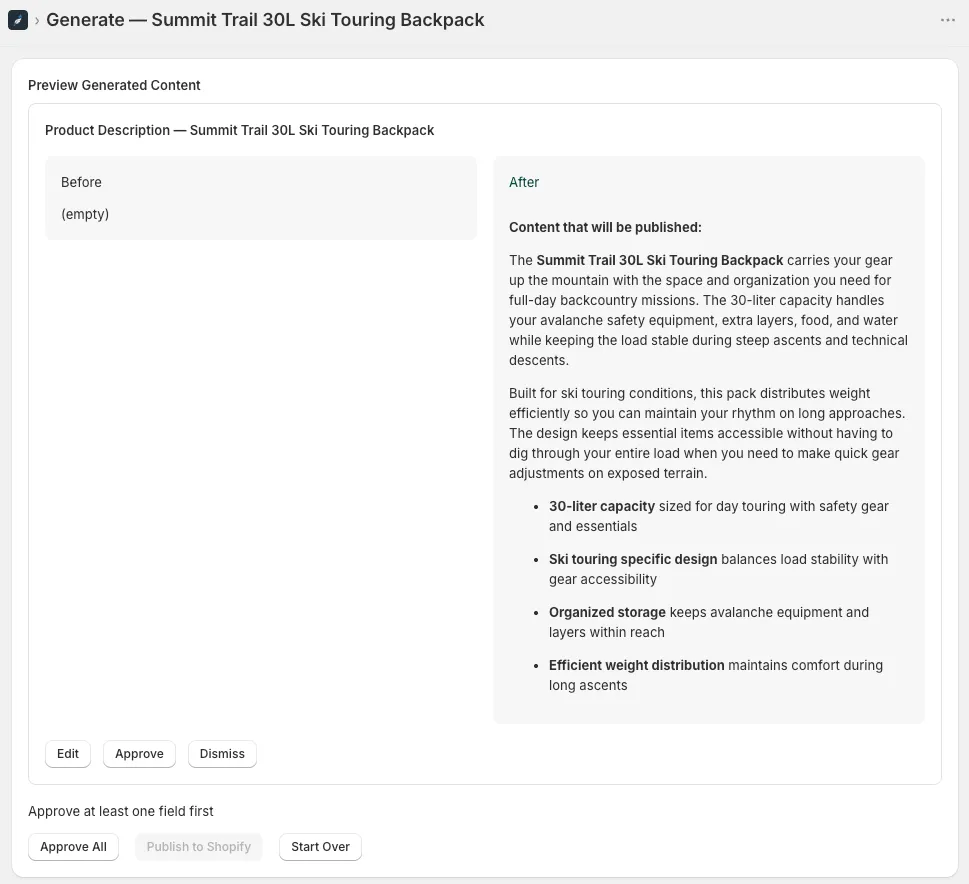
Mine is InkForge, an AI product description app for Shopify with preview and rollback: the free plan is 50 credits a month, and one credit covers one complete product, the description, meta title, meta description, and alt text together. The preview diff, version history, and the brand voice builder are included on free, with the voice builder capped at one voice. The gates are bulk generation with per-product approval and additional brand voices, both on the $15 Starter plan.
Monthly credits are a plan; one-time credits are a trial
Here’s the distinction that matters more than the credit counts: a free plan that refreshes monthly is a plan you can run a small store on; a one-time credit pool is a trial with a free label. Neither is dishonest, but they’re different products.
On the monthly kind, the math is friendly. Profitonium’s 100 or my 50 credits refresh every month, so a store with fewer than that many products can rewrite its whole catalog over a month or two and then cover every new product and seasonal refresh, indefinitely, for free. A 30-product store on a monthly tier never has a reason to pay: month one rewrites the catalog, and every month after covers the trickle of new products and reworded bestsellers. On the one-time kind, StoreYa’s 120 and Avada’s 150 are sized to prove the output quality and run out right as you’re convinced.
Watch the quieter gates too. Avada’s free tier runs a smaller model than its paid tier, so the output you’re judging isn’t the output you’d buy. StoreYa’s free descriptions are added manually, one at a time, so you’re testing the writing but not the workflow. And my free tier generates one product at a time, so you’re testing the writing and the preview, but not the bulk run. The one thing every free tier here proves honestly is voice and quality on your own products.
How to run the free test that actually decides
Twenty weird products, two tools, one afternoon: that’s the whole method. Pick the products where a generator is most likely to embarrass itself (thin supplier data, odd variants, technical specs), run the same set through Shopify Magic and one or two app free tiers, and compare against the four-part structure that converts: one buyer, one promise, proof, and objections answered.
Read the three worst outputs, not the three best. Free tiers are sized to show you the ceiling; the decision should be made at the floor, because the floor is what ships to product 400 while you’re not looking.
Then judge the workflow, not just the words. What did you get to see before anything touched your live store? What happens when you want last week’s version back? Those two questions are the whole reason the paid apps differ once the writing quality converges.
And if the free tier covers your store, use it and pay nobody. A 40-product store fits inside my free 50 credits every month, meta fields and alt text included, and I’d rather you use that honestly than upgrade out of guilt. The paid plans exist for the day your catalog outgrows the meter.
FAQ: free AI product description generators
Is there a completely free AI product description generator for Shopify? Yes, two kinds. Shopify Magic is built into every Shopify plan and generates descriptions inside the product editor at no extra cost. App free tiers add automation on top: as of August 2026, Profitonium gives 100 credits a month, InkForge 50 a month, StoreYa up to 120 descriptions, and Avada 150 credits to start.
Is Shopify Magic good enough for product descriptions? For a small catalog, often yes. It’s free on every plan and writes a solid draft from your product title, features, and tone instructions. It works one product at a time on desktop, and its documentation covers the description field only, so meta titles, meta descriptions, and alt text stay manual.
What’s the catch with free AI description apps? The meter and the gates. Some free credits refresh monthly (Profitonium, InkForge), others are a one-time pool (StoreYa, Avada). And free tiers usually gate something structural: bulk generation, the stronger AI model, or the brand voice controls. Check what gate you’d hit before you rely on one.