
Why dropshipping product descriptions kill conversions
Dropshipping stores rarely die from bad products. They die from pages that look like every other store selling the same product, and the description is where a shopper checks. If your dropshipping product descriptions are the supplier’s text, your page is running an experiment it can’t win: same photos, same specs, same paragraph as dozens of competitors, and the visitor knows it in one scroll.
I’ve written the complete cleanup workflow for imported catalogs before; that guide is the how. This one is the why: the specific tells that make visitors leave, what each one says to the person reading it, and the rewrite order that fixes the damage where it costs the most.
The five tells that say “dropshipping” to a shopper
A visitor doesn’t need to know the word dropshipping to sense it; the page tells them through five signals, each with its own translation:
| The tell | What the shopper concludes |
|---|---|
| Supplier English (“Multifunction Portable For Home Travel”) | nobody at this store ever touched this product |
| Specs stuffed into the title | this is a data feed, not a shop |
| Shipping time buried or missing | they know I won’t like the answer |
| A different tone on every page | this is a flea market, not a brand |
| ”AAA+++ quality”, “best gift choice” | my scam radar was right |
(“Best gift choice” has never once decided a gift.)
Any single tell is survivable. The compound effect is the killer, because each one lowers the benefit of the doubt for the next: by the third signal, the visitor isn’t evaluating your product, they’re evaluating whether you exist. And no discount code fixes that, because a discount from a store you don’t trust is just a smaller gamble.
Why dropshipping product descriptions fail to convert
The mechanism is simple: identical copy removes every argument except price, and price is the argument a dropshipping store loses by design. When your page reads like the supplier’s listing, the shopper who notices can find the same paragraph, same photos, and a lower number in one search. The description was your one chance to sell something the source can’t: the curation, the sizing help, the shipping honesty, the sense that a human picked this product for a reason.
Trust arrives before persuasion, in the details. A page that states “ships from our partner warehouse in 10 to 15 days” converts differently than one that hides it, not because the number improved but because the store stopped acting like it had something to hide. My opinion, stated plainly: shipping honesty in the description close converts better than shipping vagueness anywhere else, because the buyer was going to find out anyway, and finding out after purchase is called a refund.
The quieter half of the failure is what identical copy does before anyone reaches the page: it gives Google no reason to rank you over the older, more established stores carrying the same text. The traffic problem and the conversion problem have the same root.
The rewrite, in conversion order
Fix pages in the order money moves through them: bestsellers first, then the tells that repeat across every page, then the long tail in batches.
- Put the shipping truth in every close. One honest line, same place, every product. This is the fastest trust repair on the list and it needs no writing talent at all. And if the real number embarrasses you, that’s a sourcing decision to make, not a sentence to hide.
- Rewrite the ten pages that pay your bills. By hand or with a reviewed AI batch, using the four-part structure: a benefit-led opening naming the buyer, lived-in detail, scannable specs, reassurance close. Keep the supplier’s facts; replace every sentence.
- Standardize one voice. Pick the audience, the personality, and the banned list once, and put “multifunction”, “premium quality”, and every claim you can’t back on it. The voice is the one thing on the page competitors can’t import.
- Batch the rest with review. The long tail matters less per page but it’s where the tone drift lives. Bulk generate, read every row before it publishes, and the flea-market effect disappears catalog-wide.
What the rewrite looks like on a real page
This is the part of the job I automated, because the volume is the reason it never gets done by hand. InkForge, an AI product description app for Shopify with preview and rollback, takes the supplier’s facts and rewrites them in your stored brand voice, one credit per product for the description, meta title, meta description, and alt text together. Every result shows next to the current text before anything publishes, whether that’s supplier paste or, like this imported product, a field that arrived empty:
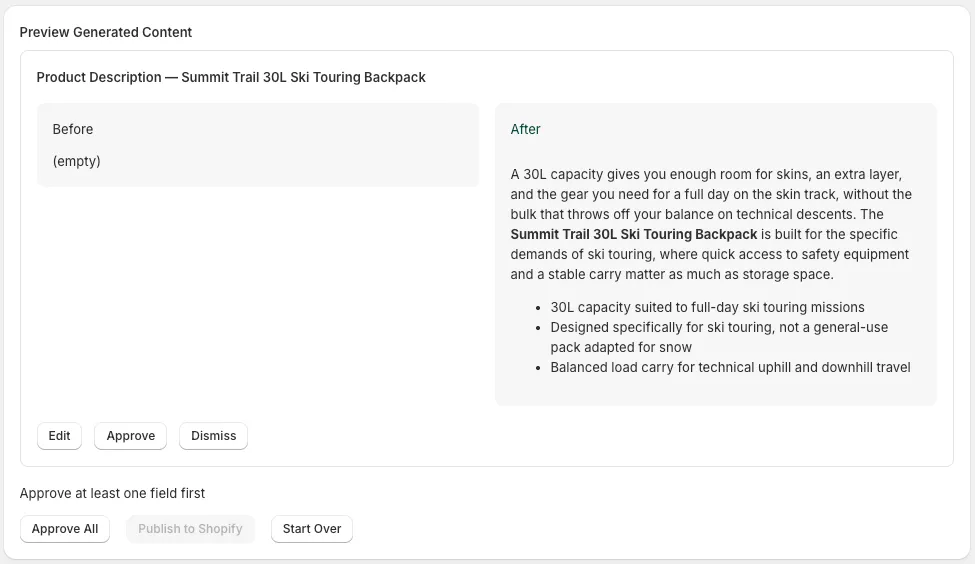
The free plan’s 50 credits a month cover the bestseller pass from step 2 with room to spare; the $15 Starter plan covers a 500-product long tail with per-row approval. Nothing goes live unread, which is the difference between fixing the trust problem and automating it.
How to tell the rewrite worked
Measure it the boring way, in your own analytics, over two weeks: add-to-cart rate on the rewritten pages against their previous two weeks, and against the pages you haven’t touched yet. Add-to-cart is the right needle because it isolates the page’s persuasion from everything checkout does afterward. Two side signals confirm it: sizing and shipping questions in your support inbox falling (the description is answering them first), and returns citing “not as described” drying up on the fixed pages.
I’m not going to promise you a conversion percentage; anyone who quotes one without seeing your store is selling something. The claim I will make is smaller and safer: pages that answer the buyer’s questions in the store’s own voice stop losing the comparisons they were losing by default.
And run the stranger test once before and after: open your bestseller next to the same product on a marketplace, and ask which page a first-time visitor would buy from, at your price. If the answer isn’t yours yet, the page still has one of the five tells. Work the list until the honest answer flips, then run the same rewrite on the next 50 products free.
The product was never the problem. The page saying nobody’s home was.
FAQ: dropshipping descriptions and conversions
Do product descriptions really affect dropshipping conversions? They’re one of the few conversion levers fully in your control. When your page carries the same supplier text as dozens of stores, the only differentiator left is price, and the marketplace selling at source cost wins that fight. Copy is the cheapest trust signal you can change this week.
Should I rewrite supplier descriptions or write from scratch? Keep the supplier’s facts, replace the supplier’s words. Specs, dimensions, and materials are accurate raw material; the framing, the broken English, and the AAA+++ claims are what kill trust. A rewrite that keeps every fact and changes every sentence gets the best of both.
How fast can I fix a dropshipping store’s descriptions? An afternoon for the pages that matter. Rewrite your ten bestsellers by hand or with a reviewed AI batch, put the shipping truth in every close, and standardize one voice. The long tail can follow in batches; the money pages can’t wait for them.