
Do AI product descriptions hurt SEO? What Google says
“Will AI product descriptions get my store penalized?” is a fair question, and it deserves a documented answer, not a vibe. So this article is built on what Google has actually published about AI content and SEO: the February 2023 guidance, the current spam policies, and the people-first content questions. The short version: Google doesn’t punish AI content for being AI content. It punishes unhelpful content, and AI is the fastest unhelpful-content generator ever built. The overlap is the trap, and it’s avoidable.
I build an AI description app, so read my bias into everything here, and then check the sources; every claim links to Google’s own pages.
What Google says about AI content and SEO
Google’s written position since February 2023 has two halves: its ranking systems aim to reward original, high-quality content however it’s produced, and using automation, AI included, primarily to manipulate rankings violates its spam policies. The same guidance points creators at E-E-A-T, experience, expertise, authoritativeness, and trustworthiness, as what the systems look for, regardless of who or what typed the words.
The document’s own FAQ settles the headline question in one line: “Appropriate use of AI or automation is not against our guidelines.” It also flattens the hype in both directions, noting that AI gives content no special gains; it’s judged as content, full stop. If it’s useful and original it can do well, and if it isn’t it won’t.
None of that is a loophole. It’s a relocation of the question: from “did an AI write this?” to “is this worth ranking?”, which is exactly the question your product pages have to answer anyway.
Where AI product descriptions become spam
The line Google draws is called scaled content abuse: generating many pages primarily to manipulate rankings rather than to help users, and its spam policies name using generative AI to produce many pages without value for users as a leading example. The policy is current, updated as recently as August 2026, and it’s aimed at behavior, not tools; the same page lists scraped content and stitched-together text from the pre-AI era.
Product catalogs sit closer to this line than blogs do, for a structural reason: a catalog is “many pages” by definition. One click can publish a thousand of them. Where each side of the line lives:
| Using AI to… | Standing |
|---|---|
| draft descriptions from your real product data, reviewed before publish | fine, per Google’s own guidance |
| write unique copy for pages that had none | fine; empty pages helped nobody |
| mass-publish unread generic text across a catalog | the behavior the spam policy describes |
| generate pages for products you don’t sell, to catch searches | scaled content abuse, plainly |
My opinion, and the sentence I’d put on a poster: the SEO risk of AI was never the model, it’s the publish button. A generator drafting from your product facts is a tool; the same generator wired straight to a thousand live pages with nobody reading the output is a spam machine that happens to be yours.
The people-first test, on a product page
Google’s people-first content questions translate cleanly to product copy, and they’re worth running on your own bestseller right now. Does the page provide original information: your measurements, your photos, how the thing actually fits or pours or sounds? If it draws on other sources, meaning your supplier’s text, does it add real value or just reword it? Would the page be useful to someone who came directly to your store, never having searched?
Notice what those questions catch: not AI, but the two classic dropshipping failures, copied supplier text and generic filler. A human copy-pasting supplier paragraphs fails people-first harder than an AI drafting from real product specs. The inputs and the editing decide the answer, which is why the fix below is about workflow, not about avoiding tools.
A concrete pair makes it visible. “Experience premium quality with this versatile product, perfect for any occasion” fails every question above, whoever wrote it. “Holds a 16-inch laptop and gym kit; the waxed canvas shrugs off rain on a bike commute” passes them, whoever wrote it. Google is grading the second sentence’s information, not its author.
Using AI descriptions without the risk
Four practices keep AI product copy on the right side of everything above:
- Feed it real facts. Materials, dimensions, use cases, your shipping promise. The model can’t know what nothing told it, and generic inputs are where generic output comes from.
- Give it a defined brand voice. Audience, personality, banned words, written down once. Voice is what separates your page from the other stores generating from the same product type.
- Review before publishing, every row. You’re the editor. The four-part structure is the checklist: one buyer named, lived-in detail, honest specs, reassurance close.
- Never mass-publish unread output. This is the whole spam policy in one habit. Volume with review is a workflow; volume without it is the thing the policy exists for.
(A search engine asking people not to spam it is not a plot twist, I know.)
On disclosure: Google says AI disclosures are useful where someone might wonder how content was created, and suggests adding them when readers would reasonably expect one. My read is that shoppers expect accuracy from a product description, not an author credit; accuracy is the obligation, not attribution.
Where the review step lives in my app
The reason InkForge, an AI product description app for Shopify with preview and rollback, is built around a preview is exactly this line: nothing it generates touches your store until you’ve seen it next to what’s live and approved it, per product, even in bulk runs. The generation draws on your product’s actual data, the voice comes from your stored audience and banned words, and version history keeps every replaced value one click from restored. It’s the four practices above, made the default path instead of the disciplined one.
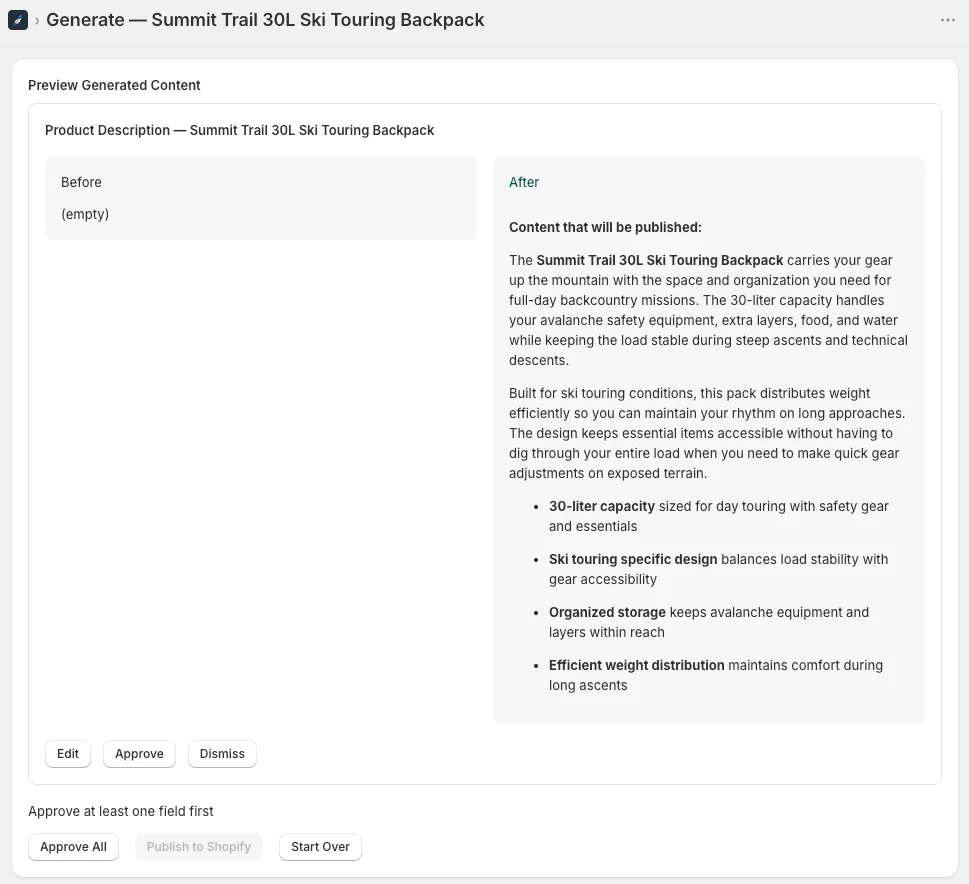
The free plan covers 50 products a month, which is enough to run the people-first test on your bestsellers with real output: generate, read, edit, publish what passes. If AI copy is going to work for your store, you’ll see it in those 50 pages before a cent or a ranking is at stake.
FAQ: AI product descriptions and SEO
Will Google penalize my Shopify store for AI product descriptions? Not for being AI-written. Google’s guidance since February 2023 is that it rewards high-quality content however it’s produced, and its own FAQ states that appropriate use of AI isn’t against guidelines. What its spam policies do target is scaled content: many pages generated primarily to rank, without value for the people reading them.
Do I have to disclose that my product descriptions are AI-written? No rule requires it. Google says AI disclosures are useful where someone might reasonably wonder how content was created, and suggests adding them when readers would expect one. My read: shoppers judge a product description on whether it’s accurate and useful, not on who typed it.
Why would AI-written pages lose rankings? Because of what they contain, not how they were made. Pages mass-generated from thin inputs read as generic, answer nothing specific, and often duplicate what other stores publish. That’s unhelpful content under Google’s systems, and at catalog scale it matches the definition of scaled content abuse.