
Brand voice guide template for Shopify (free, one page)
Your product pages sound inconsistent because they were written inconsistently: five on a good day, fifty on a rushed one, and a few hundred by a supplier who has never met your customers. The fix isn’t writing harder. It’s a brand voice guide template you fill in once, and every description after that, written by you, a freelancer, or an AI, follows the same one page.
That template is this article. It’s free, it has four sections, and filling it takes about 20 minutes. A definition first, because the term gets used loosely: a brand voice is three decisions written down: who your audience is, how you sound, and which words you never use. The guide is just those decisions plus your formatting rules, on paper instead of in your head.
What a brand voice guide is, and why one page
A brand voice guide is a one-page document that makes your store’s voice repeatable by people and tools that aren’t you. The one-page constraint is the feature. Agencies produce 40-page brand books, and those books have a failure mode every merchant knows: nobody opens them while actually writing. A guide that fits on one screen gets pasted into a freelancer brief or an AI prompt whole, which is the only place it earns anything.
Why write it down at all? Because consistency degrades with scale. The first five descriptions you write share a voice for free; page 400, written eight months later on a tired Tuesday, doesn’t. The guide is what holds the line when memory won’t.
The brand voice guide template
Copy this, fill in the brackets, delete what doesn’t apply:
BRAND VOICE GUIDE: [store name]   (version 1, [date])

1. AUDIENCE
Who actually buys: [be specific: "parents of kids under 6", not "everyone"]
What they care about: [the two or three things that decide the purchase]
What they're afraid of: [wrong size, cheap materials, slow shipping, looking silly]

2. PERSONALITY
Three adjectives: [e.g. warm, direct, a little dry]
Two example sentences, written the way we talk:
"[a sentence you'd genuinely say to a customer]"
"[another one, about a different product]"

3. VOCABULARY
Words we use: [the customer's own words for the product and its parts]
Words we never use: [the clichés and claims you're done with]
Claims we never make: [medical promises, "best in class", anything unprovable]

4. FORMATTING
Sentence length: [short and varied / long and flowing]
Bullets: [always for specs / never / only over 5 facts]
Emoji: [no / sparingly / which ones]
Capitalization: [Sentence case everywhere / Title Case for headings]
Sections 1 through 3 are the three decisions from the definition. Section 4 exists because formatting drift is the sneakiest kind: half your catalog with emoji bullets and half without reads as two stores.
How to fill it in 20 minutes
Twenty minutes splits into four blocks of five, and the trick in every block is choosing specifics over adjectives:
- Audience, 5 minutes. Read your last ten orders and your last ten support emails, then describe the person behind them. “Gift buyers who don’t know the recipient’s size” beats “shoppers aged 25 to 45” because it changes what you write: the first one needs a size guide in every description.
- Personality, 5 minutes. Skip the adjectives at first. Find two sentences you’ve actually written to a customer, in chat or email, that sound like you on a good day. Paste them in, then derive the three adjectives from them. Adjectives describe the examples; the examples do the work.
- Vocabulary, 5 minutes. Banned list first, it’s easier: the words that make you wince on competitor sites. Then the used list: the words your customers say in reviews. If they say “cozy” and you write “comfortable”, their word wins.
- Formatting, 5 minutes. Decide once, per store: sentence length, bullets, emoji, capitalization. There are no wrong answers here, only unmade decisions.
(My own banned list has 20 entries. I can’t tell you my least favorite; it’s banned.)
While you fill it, dodge the five mistakes that make voice guides useless, because I see the same five everywhere:
- Adjective soup. “Premium, friendly, professional, fun” with no example sentences is a horoscope: true of every store, useful to none. The examples are the guide.
- No banned list. The fastest section to fill and the one most guides skip. If nothing is banned, nothing is decided.
- Describing the store you wish you ran. A guide written for an imaginary luxury brand produces copy your actual customers find strange. Write the voice that matches your prices and your people.
- One voice per product. Voice belongs to the store, or at most to a collection. Per-product voices are the inconsistency you started with, formalized.
- Keeping it in your head. An unwritten voice can’t be delegated, prompted, or argued with. The document is the point.
Then version it. When the voice shifts, and it will after the first 50 descriptions teach you what’s wrong with it, save the file as version 2 and note what changed. A voice guide that never updates is a guess that never got graded.
Putting the guide to work on every description
A voice guide earns its 20 minutes the first time someone who isn’t you writes in your voice, and that someone is usually an AI tool. Paste the whole page above your prompt and the difference is immediate: generic direction like “friendly and professional” produces the same paragraph every store gets, while a named audience, two example sentences, and a banned list produce copy that could only be yours.
This is also the difference between a voice and a tone dropdown, which I’ve written about before: a dropdown holds one adjective, and your guide holds the two decisions the adjective skips, who’s buying and what you refuse to say. My opinion, plainly: an imperfect voice guide beats a perfect instinct, because instinct doesn’t survive delegation. The merchant with a mediocre one-pager gets consistent copy from every tool and freelancer; the merchant with great taste and no document rewrites everything forever.
The guide pairs with structure, which is a separate job: the voice decides how the words sound, and the four-part description structure decides what order they come in. One page each, and together they’re the whole writing system.
Where the guide lives if I build your workflow
If you use my app, the template above is a screen instead of a document. InkForge, an AI product description app for Shopify with preview and rollback, stores your brand voice as the same three decisions, audience, personality, and banned words, and applies it to every generation: the description, meta title, meta description, and alt text, per product. Every result previews next to what’s live before anything publishes. The brand voice builder is on the free plan too, capped at one voice, alongside 50 products a month; the $15 Starter plan adds bulk generation with per-row approval and unlimited voices, which is what a store with several collections ends up wanting.
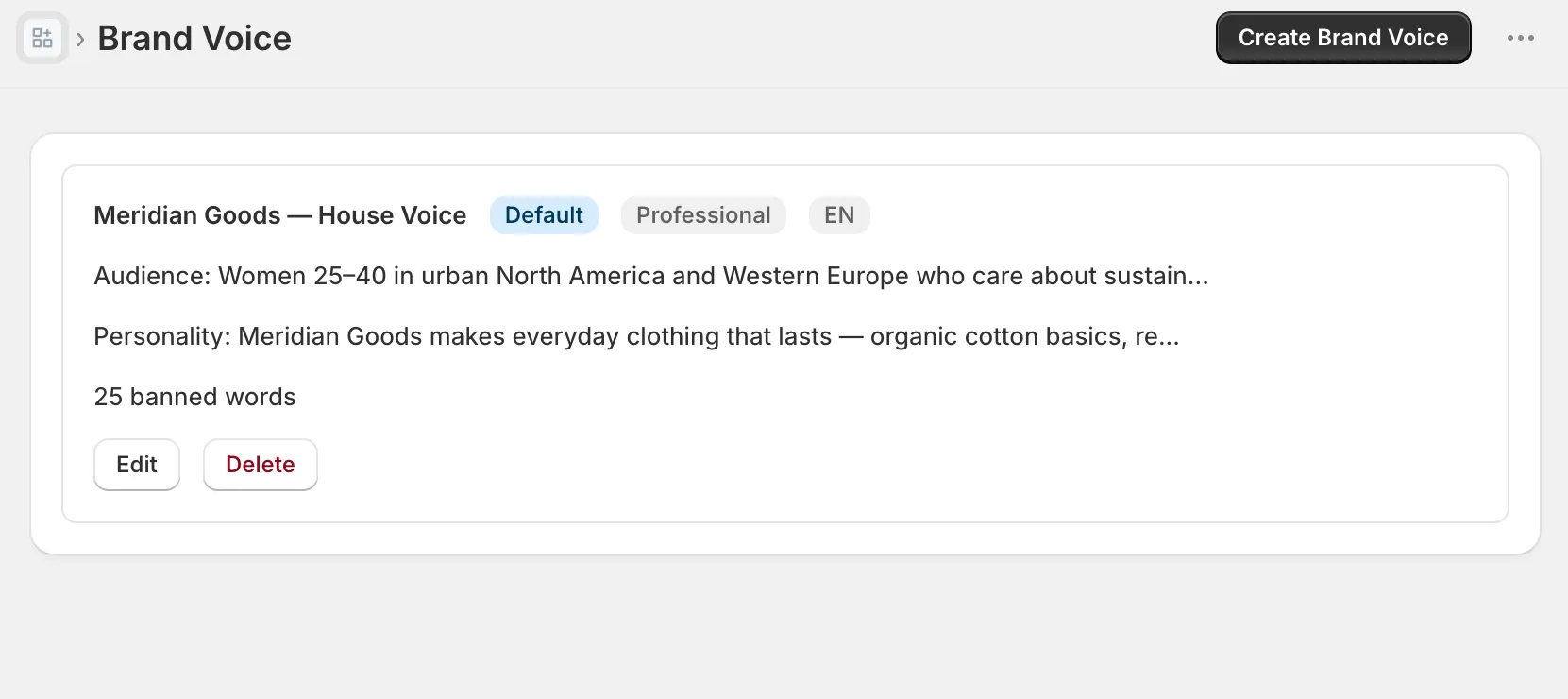
Whether the guide lives in a document or an app, the sequence is the same: fill it in once, run your ten bestsellers through it, and read the results side by side. If they sound like one store, the guide works. If they don’t, tighten the example sentences, which are the part doing most of the steering, and run the next batch on the free plan until it holds.
FAQ: brand voice guides
What should a brand voice guide include? Four sections: audience (who buys and what they fear getting wrong), personality (three adjectives plus two example sentences), vocabulary (words you use, words you ban, claims you never make), and formatting rules (sentence length, bullets, emoji, capitalization). One page covers all four.
How long should a brand voice guide be? One page. A brand voice guide only works if it gets read before writing, and nobody re-reads a 40-page brand book at product number 400. Four short sections filled with specifics beat a long document full of adjectives.
Can AI tools follow a brand voice guide? Yes, if the guide is explicit. Vague direction like professional but friendly produces generic text; a guide that names the audience, shows two example sentences, and lists banned words gives an AI the same constraints a human writer would follow, and the output holds the voice.