
Describely alternatives: when a Shopify-native app wins
Most people searching for a Describely alternative got there one of two ways: the per-product math came out higher than expected for their catalog, or the platform is built for a bigger content operation than one store needs. Both are fixable without drama. Describely is a genuinely strong product content platform; it’s just priced and shaped for a specific kind of catalog, and a lot of Shopify merchants aren’t it.
Here’s the short version. Describely charges $0.75 per product, pay as you go, and is built for teams pushing content to several platforms. Shopify-native description apps charge $15 to $19 a month and live inside your admin. Which one is right is a unit question, not a quality question: per-product pricing buys content for each product once; subscription pricing rents monthly generation capacity for one store.
All numbers below come from Describely’s pricing page and the public Shopify App Store listings, as of August 2026.
What Describely is, and where it’s genuinely strong
Describely is a standalone product content platform: it connects to your catalog, generates descriptions, titles, and meta fields in bulk, and pushes them back through connectors for Shopify, WooCommerce, Wix, Squarespace, Akeneo, or plain CSV. Pricing is pay-as-you-go: $0.75 per product for up to 500 products, with unlimited regenerations for any product you’ve paid for, data enrichment at $0.55 per credit, image processing at $0.05 per credit, and custom pricing with custom seats above 500 SKUs. The first 5 products are free, no card required.
The strengths are real. Data enrichment fills in sparse supplier attributes before writing, which is a step most Shopify apps don’t have at all. Content rules hold your brand guidelines across a team. There’s a content audit for catching unsupported claims, and the case studies on their site are operations like Target Australia, not side projects. (Their homepage case study is Target Australia. Mine is a dev store full of test products. I’m at peace with it.)
If that’s your shape (a content team, several sales channels, supplier data that needs cleaning before anyone writes a word), Describely is not a tool you need an alternative to.
Per-product or per-month: the math that decides
The honest comparison is between pricing units, because the units punish different stores. Here’s the shape of it:
| Describely | Shopify-native apps | |
|---|---|---|
| Pricing | $0.75 per product, pay as you go | roughly $15 to $19 per month |
| What you’re buying | that product’s content, with unlimited regenerations | a monthly credit pool (500 to 5,000 credits) |
| Free | first 5 products | 50 to 150 credits, some monthly |
| Platforms | Shopify, WooCommerce, Wix, Squarespace, Akeneo, CSV | one Shopify store |
| Lives | in its own platform, synced by connectors | inside the Shopify admin |
| Built for | content teams, agencies, distributors | one merchant, maybe two |
Where Describely wins: a stable catalog. A 400-product store that rarely changes pays $300 once, keeps unlimited regenerations on those products, and never sees a renewal. A $15-a-month app costs $180 every year, forever. If your catalog stands still, pay-as-you-go is the better deal by year two, and I’d rather tell you that here than have you discover it annoyed.
There’s also a third option no pricing page will volunteer, mine included: subscribe to a $15 native app for one month, clean the whole catalog inside its 500 credits, and cancel. For a static catalog that’s the cheapest route of all, and I’d rather you do that than pay for months you don’t use.
Where it flips: churn. A dropshipping store testing 200 new products a month pays $150 a month at $0.75 each, against $15 flat for a native app’s 500-credit plan. My opinion, plainly: if your catalog turns over every week, per-product pricing is a tax on your business model, and a flat subscription is insurance priced for it.
The multiplier: channels. Selling the same products on Shopify, WooCommerce, and a marketplace feed makes Describely’s one-payment-per-product model attractive, because a native Shopify app only ever writes to the one store it’s installed in.
And both units carry a workflow cost the price tags don’t show. Describely means a second platform: connector setup, syncing, a separate login, and product content living outside the admin. A native app means Shopify-only, with the work happening where you already are: no connector, no export step, no second place for content to be right while the store is wrong.
When a Shopify-native app is the right Describely alternative
If you sell on one Shopify store, want the workflow inside the admin you already use, and your catalog keeps moving, a native app is the boring correct answer. You skip the connector setup, the separate login, and the per-product meter; you pay a flat monthly price sized for continuous work.
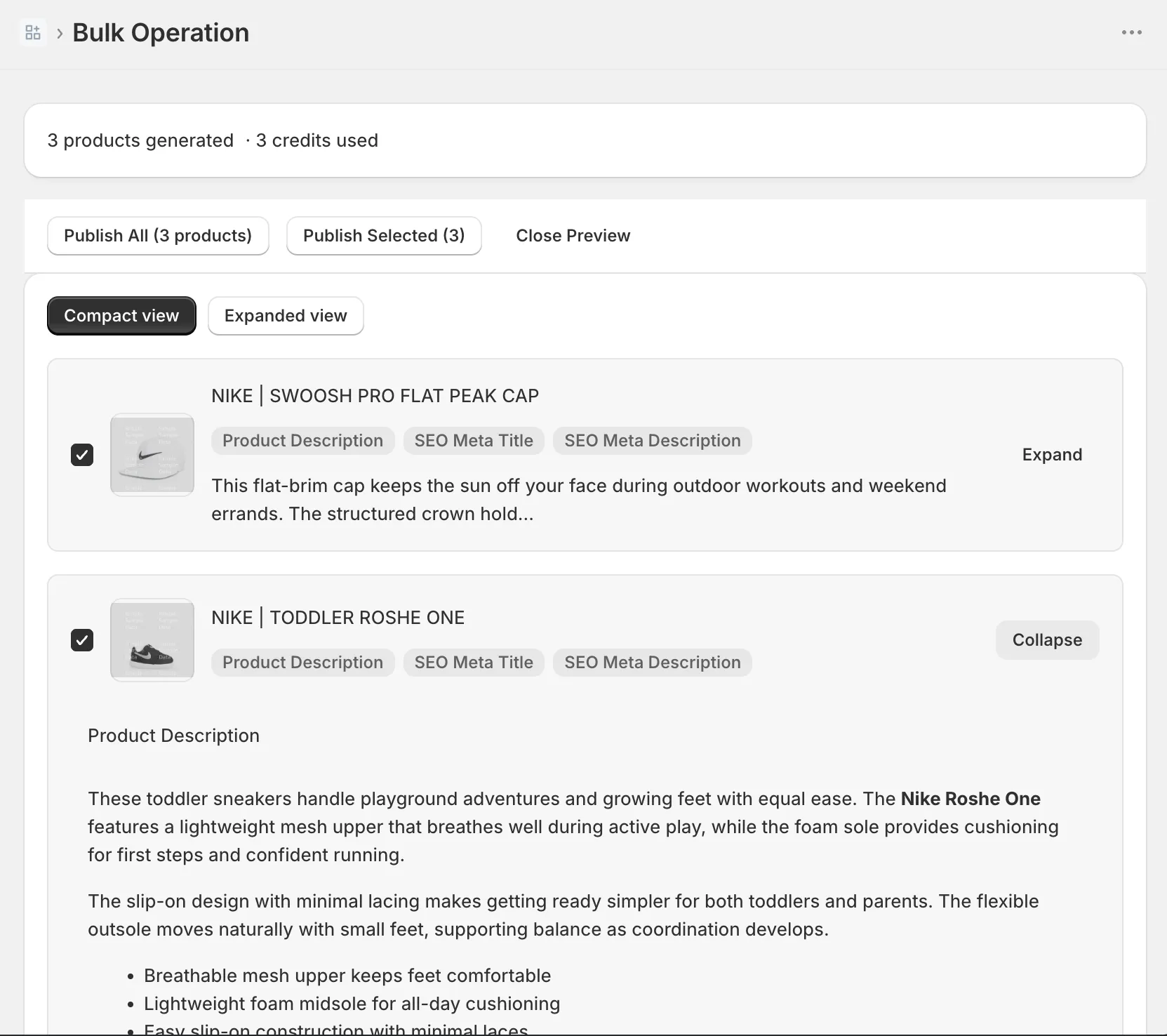
That’s the shape InkForge, an AI product description app for Shopify with preview and rollback, is built for. One credit covers one complete product (description, meta title, meta description, image alt text) in a brand voice defined once from your audience, personality, and banned words. The $15 Starter plan covers 500 products a month with bulk generation and per-row approval; the free plan covers 50 a month, one product at a time. And because bulk publishing is the risky part, every change previews as a side-by-side diff and every published version stays one click from restored.
The rest of the native field is covered in my four-app comparison: Profitonium for multilingual volume, StoreYa for blogs and newsletters beyond the product page, Avada for maximum credits per dollar. All of them sit between $15 and $19 a month, which is what makes the subscription math above work.
When Describely is still the right call
Keep Describely on your shortlist if any of these is true: you publish the same catalog to two or more platforms, your supplier data is too thin to write from and needs enrichment first, several people touch product content and you need shared rules and review, or you’re past 500 SKUs and want pricing scoped to your catalog rather than a consumer plan. It’s also a sensible shape for agencies, which pay per client catalog cleaned instead of holding a subscription per store. A $15 Shopify app doesn’t replace an enrichment pipeline, and I’m not going to pretend mine does.
Run the free test before paying either
Both models let you decide with zero dollars: Describely’s first 5 products are free, and every native app in this article has a free tier, compared in detail here. Run the same handful of awkward products through both shapes and judge three things: the writing, the workflow (how content gets back into Shopify, and what you see before it does), and the unit your store would actually pay for.
If the native shape fits, start with the free 50 products and let the output argue for itself. If the platform shape fits, use Describely and don’t look back; the right tool is the one shaped like your catalog.
FAQ: Describely alternatives
How much does Describely cost? As of August 2026, Describely is pay-as-you-go: $0.75 per product for up to 500 products, with unlimited regenerations for products you’ve paid for, data enrichment at $0.55 per credit, and custom pricing above 500 SKUs. The first 5 products are free, and there’s no subscription.
Is there a free Describely alternative for Shopify? Yes. Shopify Magic is built into every plan and drafts descriptions in the product editor. App free tiers go further: as of August 2026, Profitonium includes 100 credits a month, InkForge 50 a month with meta fields and alt text included, StoreYa up to 120 descriptions, and Avada 150 credits to start.
Is Describely worth it for a single Shopify store? It depends on catalog churn. A stable catalog can pay $0.75 per product once and be done, which beats a subscription over time. A catalog that adds products every week keeps paying per product, and a flat $15-a-month Shopify-native app is usually the cheaper and simpler fit.