
Product description length for Shopify: how long is enough?
“How long should a product description be?” is the wrong question wearing the clothes of a right one. A $9 phone case and a $900 espresso machine don’t need the same word count; they need the same decision covered: everything standing between this buyer and Add to cart, and nothing else. Product description length is an output of that coverage, not a target you write toward.
This guide gives you the working numbers anyway, because “it depends” is useless at 4pm on a writing day: the length bands by price point I use, what Google actually says about word count (less than you’d think), and the signs a specific page is too short or too long.
What Google says about product description length
Google has no preferred word count, and says so in writing. Its people-first content guidance includes a self-assessment question asking if you’re writing to a particular word count because you’ve heard Google prefers one, and answers itself in three words: “(No, we don’t.)”
That should retire the “300 words minimum for SEO” rule that still haunts merchant forums, and the padding it produces. When longer pages outrank shorter ones, the length is a symptom: the page answered more of what buyers ask, so it earned more queries. Word count is the shadow, coverage is the object. Write to the questions, and the meta fields, which do have working limits, will take care of how the page looks in the results.
Product description length by price point
The right product description length is the shortest text that answers every question standing between this buyer and Add to cart. Price is the best proxy for how many questions that is, because a buyer’s research grows with their risk. The bands I use:
| Price band | Buyer mode | Words that usually do it | Must cover |
|---|---|---|---|
| under $25 | impulse | 50 to 80 | who it’s for, the payoff, key specs |
| $25 to $150 | considered | 100 to 150 | benefits, objections, sizing, care |
| over $150 | researched | 200 or more | the full story, comparisons, guarantee |
These are my guidelines, not laws of physics; they come from reading a lot of product pages, not from a dataset I can hand you. A $19 impulse buy needs a vibe and four facts. A $120 jacket needs the fit answered, the fabric justified, and the return policy visible. A $900 machine has earned real copy: what it replaces, who it’s wrong for, what the warranty covers, because its buyer is reading three other tabs right now.
The bands bend for category quirks: technical products need spec depth regardless of price, and gifts need recipient language even when cheap. Bend them; don’t ignore the direction they bend from.
Signs a description is too short, or too long
Too short announces itself off-page: sizing questions in support email, returns citing “not as expected”, a bounce straight back to search. Each one is a question the page should have answered and didn’t. The fix isn’t length for its own sake; it’s the missing answer, which usually adds two sentences, not two hundred words.
Too long is quieter, because nobody emails you about padding; they just stop reading. The tells live in the text: paragraphs restating the title, spec bullets repeated in prose, an “About our brand” essay above the product facts, and any block that exists because a word-count rule demanded it. Cut order: adjectives first, repeated claims second, brand throat-clearing third. The facts go last, and usually don’t need to go.
And guard the first line at any length, because it does double duty: it’s the hook on the page and often the snippet Google shows when your meta description is weak. “Introducing our newest addition” fails both jobs in four words.
Where the words go inside the page
Length isn’t spread evenly; each of the four parts of a description has its own budget, and respecting them matters more than the total. The hook gets one sentence at any price point, because two hooks are none. The lived-in middle scales hardest with price: one sensory sentence for the $15 mug, three for the $120 jacket, a full paragraph plus comparisons for the $900 machine. Spec bullets grow by fact count, not by prose: four bullets or eight, but never sentences pretending to be bullets. The close stays at one or two lines everywhere, because reassurance works by being findable, not long.
That distribution is also the fix for most “wrong length” pages: a 150-word description that still fails is often mostly hook and no specs. Rebalance before you resize.
Holding sensible lengths across 500 products
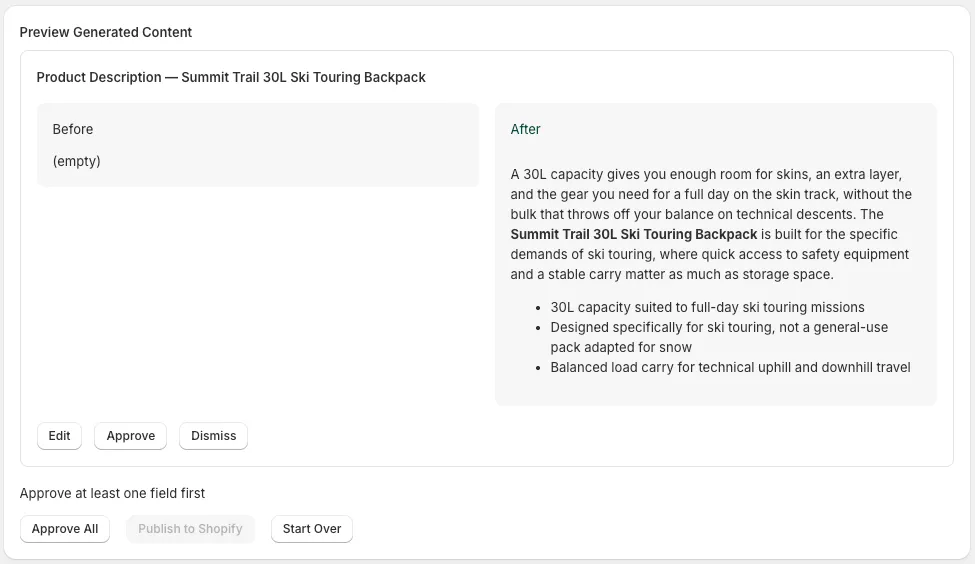
Consistency of coverage is worth more than any specific count, and it’s the part that breaks at catalog scale: page one gets 140 well-chosen words, page 400 gets whatever was left in the tank. This is where I’ll mention my own tool once. InkForge, an AI product description app for Shopify with preview and rollback, generates each product’s description in your stored brand voice along with the meta title, meta description, and alt text, one credit per product, and shows everything in a preview next to what’s live. That preview is where length judgment happens per product: you read, trim, or extend before approving, and your bestsellers still deserve the hand edit.
(This article runs about 1,200 words. I checked, for obvious reasons.)
The free plan covers 50 products a month; the $15 Starter plan covers 500 with bulk generation and per-row approval. Neither will tell you the right length for your catalog. The preview will, 50 products at a time, starting with the free ones.
The test that replaces the word counter
Take your bestseller and delete every sentence that doesn’t answer a buyer question or advance a reason to buy, then read what’s left. If it’s 60 words on a $15 product, that’s the right length. If it’s 220 on a $300 product and a sizing question is still open, it’s too short at 220. The word counter was never the instrument; the unanswered question was.
Run the same test quarterly on your top ten, because length drifts the way voice does: one small addition at a time, until the page is carrying sentences nobody remembers approving. The bands are a starting grid, not a finish line.
FAQ: product description length
Do longer product descriptions rank better? Not because of the length. Google’s own self-assessment guidance says outright that it has no preferred word count. Longer pages sometimes rank better because they answer more of what buyers ask, and that’s the part worth copying: cover the questions, and let the count land where it lands.
Is 50 words enough for a product description? For an impulse buy under about $25, often yes: one line naming the buyer and the payoff, a sensory sentence, and three or four spec bullets fit in 50 to 80 words. It stops being enough the moment a real pre-purchase question, sizing, materials, shipping, goes unanswered.
Should every product have the same description length? No. Length should follow price and buyer risk: short for impulse items, 100 to 150 words for considered purchases, 200 or more for expensive products where the buyer researches. A uniform length across a catalog means half the pages are padded and half are thin.